
Muskegon Previous Residents by Era
The sources below cover separate parts of a backward address trail. A title chain identifies recorded interests in a parcel, not everyone who used an address. Historical directories are dated lists, not complete household censuses. Maps show a building or block context, not a name. Use the era closest to the question first, then carry the parcel number, legal description, old street form, and dates to the next source. That method makes a search for Muskegon previous residents easier to audit when records disagree.
| Source | Years it covers | Where held | What it shows |
|---|---|---|---|
| Recorder index | Portion of 1859 to present, updated daily | MuskegonRecords and Register of Deeds | Grantor, grantee, instrument type, date, and number; image conversion remains incomplete. |
| Hackley deed series | Index 1838 to 1887; records November 10, 1838 to 1928 | Hackley/Torrent House local collections | Historical deed finding aid and record series. |
| Muskegon city directories | First known edition 1873; Polk sequence described to present | Hackley main building and Torrent House | Dated name and address listings with edition-specific details. |
| Michigan state census | 1884 and 1894 | Hackley, MCGS, and Library of Michigan guides | Household enumeration for the census date and locality. |
| Muskegon Chronicle | 1869 to 2018 on microfilm; NewsBank from 1997 onward | MADL and Hackley | Moves, deaths, notices, property events, and civic references. |
| Sanborn maps | 1883, 1887, 1911 with revisions; 1923 revised 1950 also identified | Library of Congress and local reference routes | Building footprint, use, street pattern, and block context. |
Begin with a current parcel or the latest transfer when the question starts in the recent period. For an early address, begin with a directory or the Hackley deed series and work toward the recorder index. City building records have a current public route, but no precise historical span was captured. Ask for an address- and date-specific search rather than assuming a complete permit history exists.
Muskegon Recorder Index Trail
The Muskegon County recorder index supplies the online part of the ownership trail. Its public index is free and covers a portion of records from 1859 to present. The index is updated daily, but handwritten and microfilmed image conversion remains incomplete. A registered user can purchase image or printing access at the published $1-per-page rate plus a convenience fee. The office also supplies in-person searching, copies, and certifications, while staff cannot provide legal advice or blank deed forms.
Search controls documented by the recorder include Both Names, Grantor, Grantee, Exact Match or Advanced matching, document type, document number, start and end dates, wildcards, operators, and Find Related. These controls support a backward search when a current address is only the starting point. A document hit needs its date, instrument type, and legal description recorded before it is used to connect past residents with the property.
The recorder search help shows the grantor, grantee, exact, advanced, wildcard, document-type, and date controls.
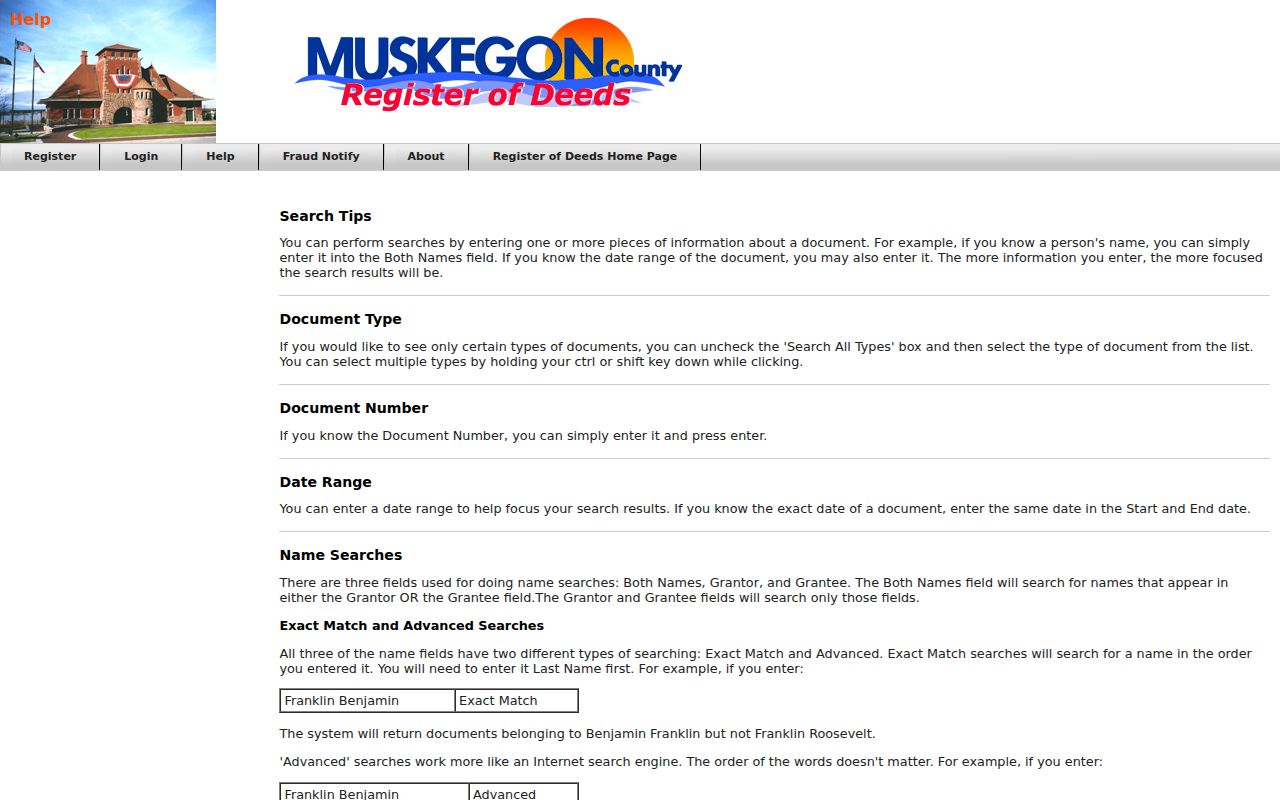
The image-access route is separate from the public index. Note whether the evidence is an index entry, an image, an office copy, or a certified copy.
Muskegon Address Forms Shifted
Old Muskegon address research must cross two documented street changes: street-name changes from 1887 through 1889 and a renumbering project in 1925. The MCGS resources identify those changes, but the full conversion table was not captured. Preserve the original directory or newspaper wording first. Then test a possible modern equivalent against a Sanborn sheet, plat, current GIS parcel, and another dated source. An unverified conversion remains a research lead, not a settled match.
Postal and municipal labels can create a second false match. Muskegon City, Muskegon Township, Muskegon Heights, North Muskegon, Norton Shores, and Roosevelt Park have different county codes and records systems even when a source uses “Muskegon.” Keep the municipality with every entry. Note: A historical street number should not be converted to a current number until the old name and renumbering evidence have both been checked.
Trace a Muskegon Deed Chain
A Muskegon deed chain runs backward from the current parcel record or a recent deed. Obtain the recorded owner name, parcel or PIN, legal description, lot or subdivision information, and latest transfer date. Search that owner as grantee to locate the purchase deed. The seller on that instrument is the grantor. Search the seller as grantee to find the seller’s earlier purchase, then repeat. Find Related and the legal description are useful when a party name appears in more than one transaction.
- Open BS&A or GIS with the current address and preserve the parcel number, municipality, and legal description. Do not treat a mailing address as the property address.
- Find the latest recorded transfer in the Register of Deeds index. Record the document number, document type, date, grantor, grantee, and legal description.
- Search the named grantor as a grantee to locate the preceding acquisition. Compare the parcel and legal description before adding that record to the chain.
- Repeat backward and label mortgages, releases, assignments, and corrections as related instruments, not automatic ownership changes.
- When online images or a date range ends, use the Register of Deeds office, Hackley/Torrent House deed material, or the Archives of Michigan guide for the next historical route.
- Grantor and grantee
- The grantor transfers an interest named in an instrument. The grantee receives that interest. Their names identify parties to a record, not a complete list of people at the address.
- Chain of title
- A sequence of recorded transfers or interests linked through a parcel and legal description. It is an ownership trail, not an occupancy trail.
- Legal description
- The recorded land description, such as a lot, block, subdivision, or unit. It remains more stable than a street number when names or numbering changed.
- Criss-cross directory
- An address-arranged directory section that can move a researcher from an older street number to a dated listing.
- Enumeration district
- The census area used to organize a count. It helps locate the proper census page but does not replace the address evidence.
Muskegon Ownership and Occupancy
Past residents and past owners are related but different research questions. A tax result can separate the property address from the owner’s mailing address. A deed records an instrument and the parties to it. A directory can place a person at an address in a particular edition. A newspaper or census can add a household-level date. Each record should be written in its own terms rather than collapsed into a single claim that someone lived there.
This distinction is especially important when a parcel changed use or a person appears as a mail recipient, business contact, or recorded party. Homestead information, if it appears in a live assessment result, can support an owner-occupancy inference but is not conclusive proof. Build parallel columns for the title chain, the listed-at chain, and the tax-mail chain. That preserves uncertainty instead of creating a false history.
Muskegon Past Directory Pairings
Once a transfer date points to an era, use the address history to look for previous residents in the nearest city directories and census material. Hackley’s first known Muskegon city directory is the 1873 A. Bailey edition, with later volumes mostly issued by R.L. Polk. Newer volumes are at the main Hackley building and older volumes at Torrent House. Search the address section where present, then verify the name in the alphabetical section. The collection details belong on the Muskegon city directory collections page, while this trail uses each edition as a dated address check.
Pair a directory entry with the nearest available census year without treating them as the same event. The local collection includes the 1884 and 1894 Michigan state census microfilm. Federal schedules are a separate enumeration source with their own release and locality rules. Chronicle microfilm can bridge the gap with a move, death, marriage, business notice, or neighborhood event. For a request, MADL’s obituary or article form needs the deceased person’s name, death date and place, requester contact, and delivery choice.
- Copy the address exactly as it appears in one directory, including directional wording and abbreviations.
- Check the alphabetical section in that edition, then compare the prior and following directory editions for a first appearance, move, or disappearance.
- Match the closest applicable census year and locality. Record the enumeration date instead of assuming the annual directory and census describe the same day.
- Search the Chronicle, obituary indexes, or an appropriate newspaper date window for a dated event that supports or corrects the directory trail.
Use “listed at” when a directory line is ambiguous. It is safer than claiming a full household from a single publisher’s entry.
Muskegon Sanborn Address Context
Sanborn maps help test the physical context of a historical Muskegon address. The identified runs include 1883, 1887, and 1911 material with later revisions, plus references to 1923 revised 1950. Compare the sheet year and revision notation with the directory year. A map can show whether the address fell in a residential block, a mill corridor, a shop area, an institutional setting, or a later subdivision. It does not identify a person, prove a title, or replace a dated directory line.
The Library of Michigan Muskegon County guide is a useful route to county historical series and archival context.
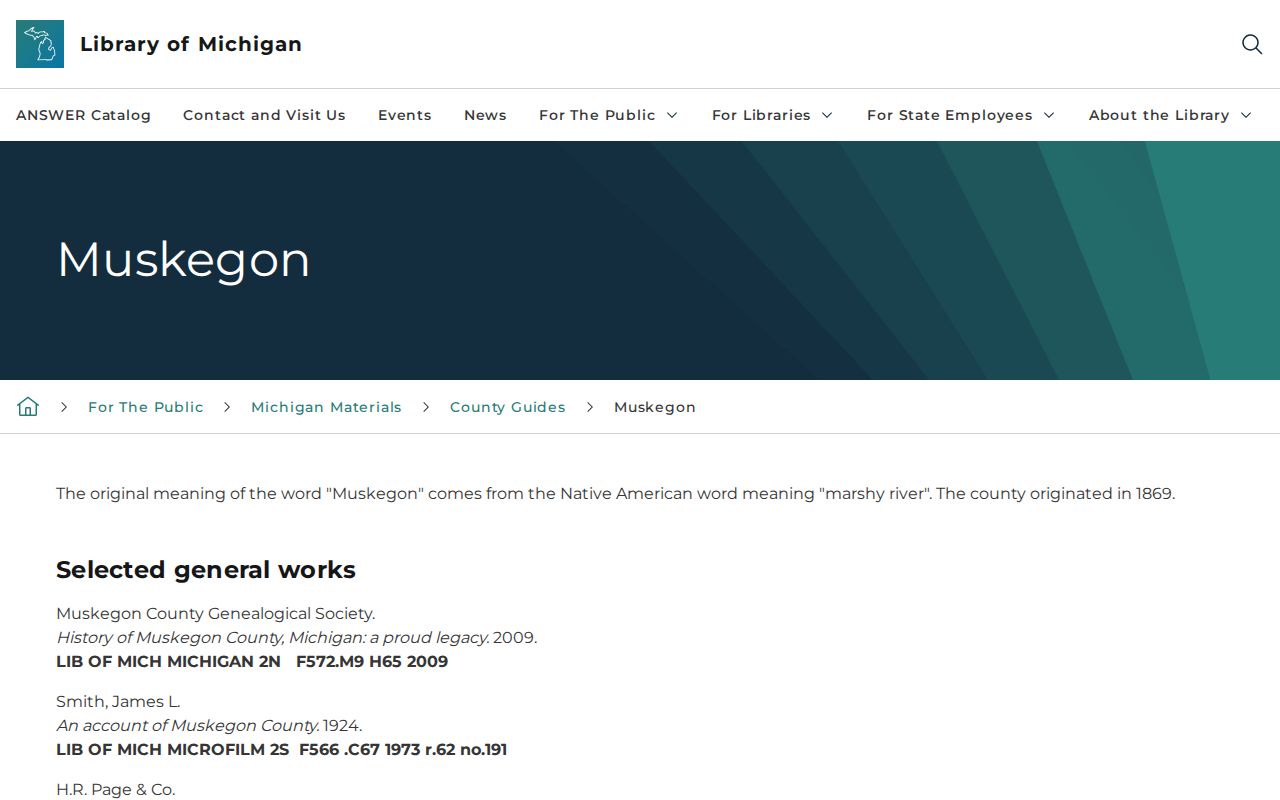
When the recorder’s digital images stop, the guide helps direct the next step toward library, archive, or local record series rather than assuming the trail ended.
Muskegon Obituary and Probate Ends
An address story can end with a move, death, estate, or change in use. MADL has Muskegon Chronicle microfilm from 1869 through 2018, a ScanPro reader, NewsBank full text from 1997 onward, and color page scans from September 2018 onward. Hackley also holds newspapers. MCGS adds cemetery, census, street-name, newspaper, vital-statistics, marriage, coroner, map, land, homestead, military, and patent databases. These are finding aids and context layers, so a significant claim should return to the underlying record where possible.
The MCGS history describes a 26-volume Clock Funeral Home collection spanning 1894 to 1948 and long Chronicle indexes. A cemetery location, obituary, death record, and probate file can each supply a different date or spelling. Probate access is file-specific, and court or clerk staff should confirm whether a particular file is public and what copy route applies. An estate document may name heirs or addresses, but that does not establish the decedent’s last address without a dated supporting record.
Muskegon Previous Residents Limits
Previous-resident research has firm limits. Utilities are not a public customer-name source in the inspected material. A parcel map, tax roll, recorded deed, or mailing address does not disclose every person associated with a property. Michigan Address Confidentiality Program participants may use a substitute address, and a missing or different public entry is not permission to uncover a protected location. Court, vital, and archival materials can also have access limits, redactions, or request rules.
Keep a simple source log for each Muskegon address: exact source title, record date, page or document number, original address wording, parcel or legal description, municipality, and a confidence note. Mark an entry direct when it names a person, address, and date; indexed when only an index hit is available; context when it describes the block; and unresolved when the sources conflict. For a current address chain rather than a past-household question, the Muskegon street address directory keeps the parcel and GIS steps in one workflow.
Lawful use. Use Muskegon previous-resident records for lawful house history, family history, estate research, or personal curiosity. Do not use any result to stalk, harass, track, or harm a living person.