
Muskegon City Directory Shelf
Hackley Library identifies the first known Muskegon city directory as an 1873 volume published by A. Bailey. Later editions are mostly R.L. Polk. The library describes Polk directories as continuing to the present, but the research did not locate a final printed year. Newer volumes are held in Hackley’s main building, while older material is at Torrent House. Check the particular edition and physical location before making a trip.
| Collection | Years | Where Held | Access |
|---|---|---|---|
| Muskegon city directories, Bailey and later Polk sequence | First known 1873; later Polk sequence, described as continuing to present | Newest volumes at Hackley main building; older volumes at Torrent House | Use alphabetical and, where included, address sections; verify edition and page |
| Digitized historical directory item | Item-specific year must be checked in the scan | Google Books historical-directory landing | Inspect the item and preserve its displayed publication details |
| Muskegon Chronicle microfilm | 1869-2018; NewsBank 1997 to today; color scans from September 2018 | Muskegon Area District Library and Hackley holdings | Microfilm, reader, NewsBank, or obituary/article request route |
| State census microfilm | 1884 and 1894 | Hackley, MCGS, and Library of Michigan guide routes | Use the exact enumeration year and locality |
The table separates a directory run from companion sources. A directory is a dated listing, not a complete account of everyone in Muskegon. The nearby newspaper and census sources can confirm a move, an event, or an address context without turning a single line into a broad claim.
Muskegon Directory Years
The historical timeline is useful because it marks both what is known and what still needs inspection. Muskegon County was organized in 1859, and the City of Muskegon incorporated in 1869. The known directory era starts after those dates, with Bailey’s 1873 volume. Later Polk volumes continue the local address trail, but a precise stop year was not found in the inspected material.
- 1859: Muskegon County organization begins the county record period described by the Archives guide.
- 1869: Muskegon becomes an incorporated city.
- 1873: A. Bailey publishes the first known Muskegon city directory.
- Later years: R.L. Polk directories form most of the identified sequence.
- Current holdings: Hackley says the latest volumes are at the main building, while the last printed year remains a research gap.
That last point matters. Do not report an unverified final year, a publisher transition date, or a missing-year pattern. Ask to see the requested edition, its title page, and its index before treating a shelf description as a complete bibliography.
Reading Muskegon City Directory Entries
The local newsletter supports a small, useful inventory for a Muskegon city directory entry: a listed name, occupation, street address, length at an address, and an occasional property-value note. Later volumes can also contain address sections. Those are the fields supported by the local material, and each one should be copied exactly with the edition year and page.
| Listed name | The alphabetical entry used to locate the dated listing. |
|---|---|
| Occupation | A local field documented by the directory newsletter; record its wording without expanding it. |
| Street address | The address associated with the entry for that edition, then checked against any address section present. |
| Length at address | A note the newsletter says can appear; retain it only when the inspected entry shows it. |
| Property-value note | An occasional local note, not a universal field. Copy it only when visible. |
The research did not capture a full Muskegon sample page or its local abbreviation key. Avoid adding marks, relationship details, ownership labels, or shorthand rules from a different city’s volume. The page image is the authority for the exact column headings and abbreviations in the edition being used.
Muskegon Directory Terms
Directory language changes by publisher and year. Use the words in the book first, then add a plain explanation in a research log. This keeps a later address section or a notation from being mistaken for a fact that every Muskegon volume contains.
- Alphabetical entry
- A listing arranged by the name printed in that edition. It is the starting point for comparing a person across years.
- Address section
- A section arranged by street address when the particular later directory includes one. It can be used to cross-check the alphabetical listing.
- Criss-cross directory
- A directory format that organizes listings by address as well as by name. Confirm that the specific Muskegon volume has this format before relying on it.
- Abbreviation key
- The explanation of the volume’s shortened terms or marks. The local key was not captured in the research, so photograph or transcribe it from the volume itself.
Note: Keep a scan’s title, year, page, section, and any visible abbreviation key together in the same citation.
Tracing Muskegon Directory Households
A household trail works best as a short sequence of dated observations. Start with one alphabetical listing. Write down only the occupation and address fields actually shown. Then look for the same spelling and address in the next one or two editions. The address section, when present, offers a second check on the printed location. A changed spelling, a new address, or a missing entry is a lead for more research, not a conclusion by itself.
- Locate the earliest identified name in a Muskegon city directory and record the exact edition, page, occupation, and address.
- Check the address section in that same volume when it is present, keeping the two entries as separate observations.
- Search one or two following editions for the same name, an address change, or a new entry at the prior address.
- Pair the nearest directory year with the appropriate federal census year, or Michigan’s 1884 and 1894 state census material, while keeping the different dates distinct.
- Use a Chronicle notice, cemetery index, death index, or deed record to test a move, death, or family change with another dated source.
A name that disappears may reflect a move, a changed spelling, an omitted listing, or another cause. It does not establish any one explanation. The goal is a chronology that preserves what each source actually said.
Muskegon Directory Street Changes
MCGS identifies street-name changes from 1887 to 1889 and a city street-renumbering project in 1925. Those changes can make a directory listing look like it vanished when the street name or number changed. The exact conversion table was not captured, so a modern match should stay tentative until the MCGS resource is read.
Preserve the old directory wording beside the modern candidate, along with the edition year and municipality. Then test the address against a map or parcel source. The Muskegon street address directory is the place for the present-day parcel workflow; historical directory work should not substitute a present address for the one printed in the book.
Muskegon Directories and Chronicle Evidence
The Muskegon Area District Library microfilm route provides Chronicle microfilm from 1869 through 2018, a ScanPro reader, NewsBank full text from 1997 to today, and color page scans from September 2018 onward. A newspaper can help date a move, death, marriage, business notice, or neighborhood event that appears near a directory year.
Search with a name, a date range, and an address or place when known. MADL’s obituary or article request requires the deceased person’s name, date and place of death, requester details, and delivery preference. The request service is limited to the Chronicle. A result should be cited as a newspaper notice, not used to silently rewrite a directory entry.
Note: Microfilm, OCR text, full-page scans, and staff-request results are different access modes and should be labeled that way.
Muskegon Directory Map Context
A city directory gives an address line. A map helps describe the block at that time. The Library of Congress identifies Muskegon Sanborn editions from 1883, 1887, and 1911 with later revision notation; other references identify a 1923 volume revised in 1950. These are building and street-context sources, not proof of title or occupancy.
The 1883 Sanborn item is a useful starting point for comparing a printed address with the older street pattern. Use the original map year and any revision year. A mill corridor, commercial block, waterfront, or later subdivision can explain why an address changed use, but it cannot establish who was there.
Citing Muskegon City Directories
City-directory citations need enough detail for another researcher to find the same line. State the printed title, publisher when shown, year, page, and section. For a digitized item, preserve the stable item link and image or scan number. For a physical volume, identify whether it was consulted at Hackley’s main building or Torrent House.
Use a separate note for each comparison source. A census is a household enumeration on its own date. A newspaper is a dated notice. A deed records an instrument rather than a directory listing. Keeping those categories separate makes the Muskegon chronology easier to revisit when a date or address conflicts.
Muskegon Local History Route
Hackley Library’s collection highlights identify directories alongside vital microfilm, newspapers, county census microfilm, family histories, surname cards, and deeds. Its Torrent House information describes the local-history setting, while MCGS databases add street-name, cemetery, newspaper, map, land, and funeral-home finding aids.
A visit plan should name the collection, edition or year, requested equipment, and copy needs. Local pages show differing hours, so confirm them before travel. MCGS’s history also records a 26-volume Clock Funeral Home collection for 1894-1948 and long Chronicle indexes, which may offer a second dated lead when a name is unclear in a city directory.
Hackley’s collection highlights show the local materials that sit beside the Muskegon city directory shelves.
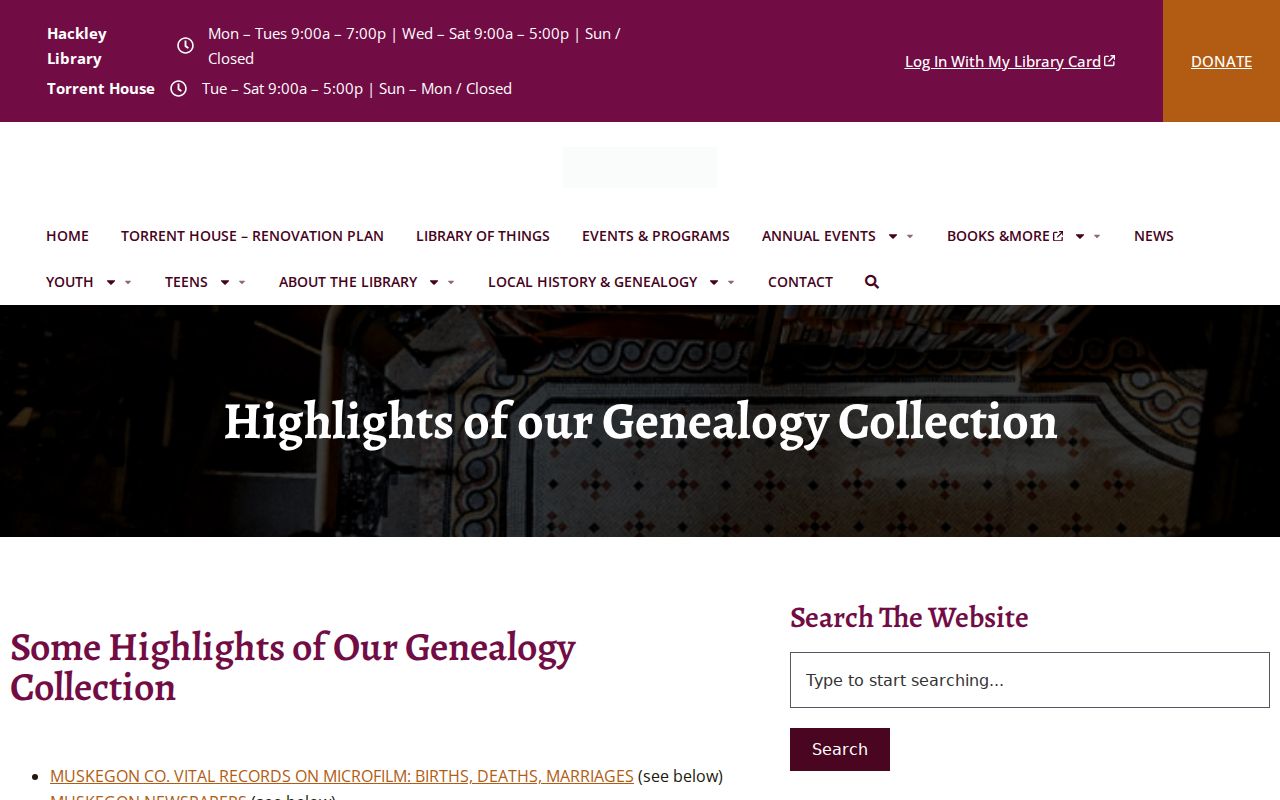
Those holdings make it possible to compare a directory line with local microfilm, census, deeds, and family-history material without treating any single one as complete proof.
A digitized historical Muskegon directory landing offers an item-level route for checking a scan before citation.
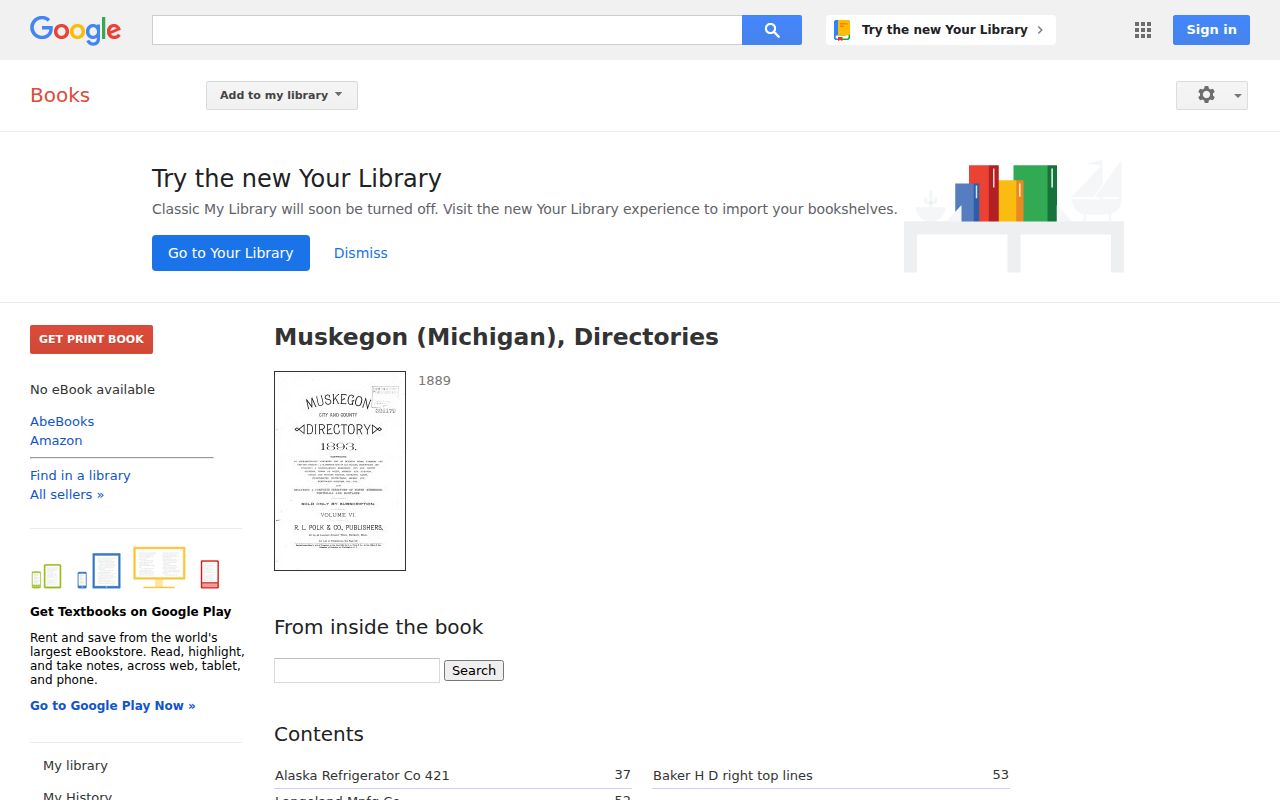
Record the title page and displayed publication details from the actual item, since the research did not establish a complete online run.
The Torrent House local-history information documents the research setting used for older directories and related source material.

Torrent House is especially useful when an older volume, map, deed series, or surname resource must be consulted alongside a city directory.
The MADL Chronicle microfilm page documents the newspaper access channels that can corroborate a directory-year observation.
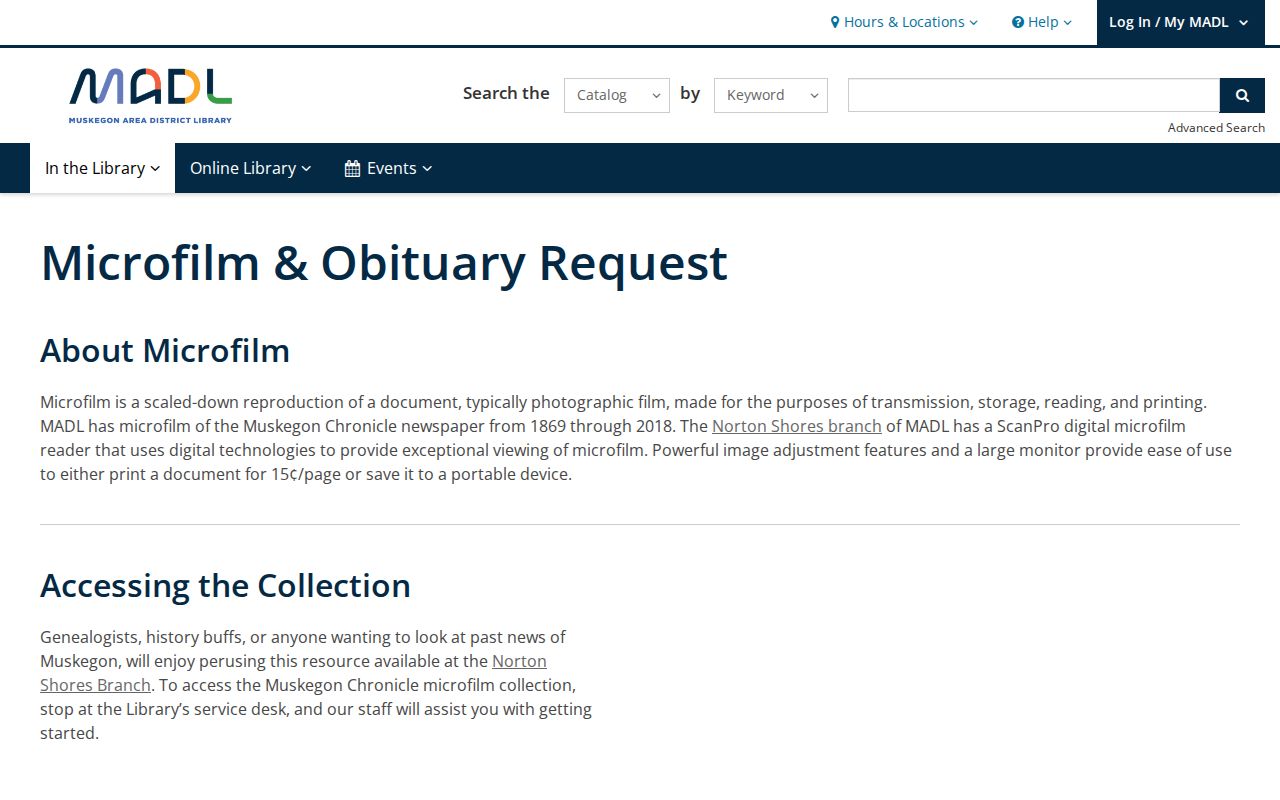
Use the newspaper date and access mode with the directory citation so a future reader can distinguish a scan, index hit, microfilm view, or staff request.